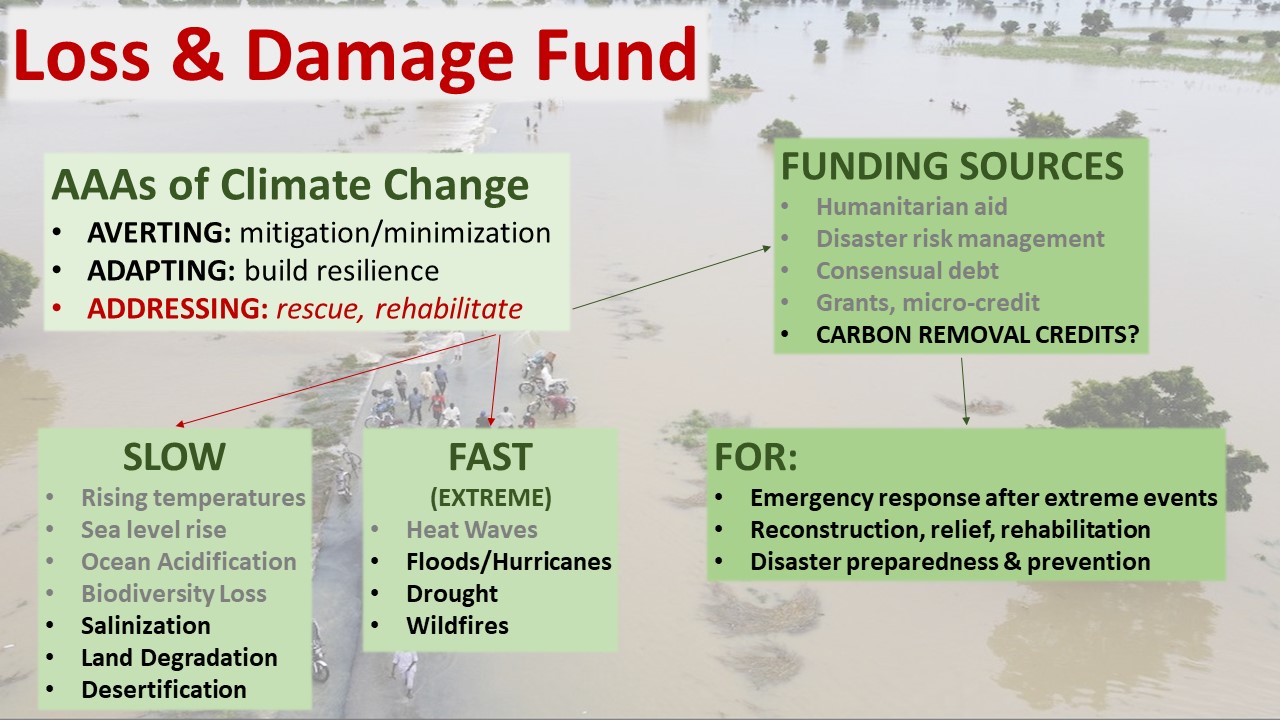
“Loss & Damage” is a relatively new term within the climate community. It refers not just to the impacts being experienced ever increasingly as a result of too many heat trapping gases in the atmosphere, but also to the activities which can and should be undertaken to address these impacts, whether they are sudden or slow, after they occur. Importantly, it also seeks to address how those activities are funded. It is focused on insuring and assisting those suffering the most from climate change that contributed the least to emitting excessive carbon into the atmosphere. This pool of funds is completely separate from funding aimed at helping countries to either reduce emissions or proactively adapt to expected changes.
Perhaps unsurprisingly the amount of funds pledged by high emitting countries to date is woefully inadequate to meet the escalating costs of rescuing communities that have been hit by extreme events exacerbated by increased atmospheric GHGs. A recent example is huge flooding due to excessive rains in 2022 in Pakistan which caused more than $30B in damages and affected tens of millions of people. The US contributed less than $100M to recovery efforts.
Roughly 3 million hectares of crop land were impacted. Loss and Damage estimates for agriculture included 3.1M bales of cotton, 1.8Mt of rice and 10.5Mt of sugar cane. Not only were these crops lost leaving farmers with no revenue and increased food insecurity, but the damaged crops most likely led to significant GHGs as they rotted in wet fields.
Now imagine if there was a way to finance the collection and carbonization of rotting residues (I acknowledge that drying during wet seasons is a significant challenge). Given the growing number of biochar-based carbon removal methodologies and growing demand for removal credits, it may now be possible to fund some sort of biochar focused disaster recovery effort using portable carbonization equipment, some of which may be able to provide needed electricity and/or heat. This could provide numerous jobs for displaced people and the biochar could be used to replenish lost soil carbon or filter water or remediate toxins or any number of other uses depending on what the most pressing needs are post-disaster.
Large multi-national corporations that are dependent on the crops could purchase these credits which will help farmers to recover faster and hopefully incentivize them to stay in farming. Or countries could purchase removal credits from the impacted countries as a mechanism of meeting their NDC targets.
Perhaps an organization such as the UN Central Emergency Response Fund could act as a facilitator, broker or verification agency when it comes to understanding the potential biomass impacted and available for carbonization. And perhaps organizations such as Rotary or Samaritan’s Purse could train locals on how to make and use biochar in the most pragmatic way based on the specific impacts from the disaster.
Biochar production from disaster debris is already happening but at very small scale in Puerto Rico and the Philippines and likely elsewhere as well. Given the increasing number and scale of climate disasters, I’d say there is no better time than now to develop this idea and test the waters for funding!
More than 12 years ago, I gave my first public presentation about biochar to a room filled with people far more knowledgeable about biochar than I was. It was a 5-minute Ignite-style talk where sound-bites are the order of the day. One of my slides is shown above and the words behind it were:
This thing called biochar covers an almost unlimited variety of products which are in fact very different. A very smart Cornellian once compared it to using the word ‘tree’ and leaping to the conclusion that all trees are the same. We need to acknowledge and understand the differences between charred products.
Fast forward to the present when biochar is finally experiencing a ‘moment’ yet we are still struggling as an industry to agree on a definition of biochar. A few times per year without fail someone in the ever-helpful biochar forum (https://biochar.groups.io/g/main/topics) rails against the misuse of the word biochar for one reason or another. A typical case is someone claiming it’s not biochar unless it’s blended with something to put the ‘bio’ in it. Or the topic comes up on LinkedIn (and probably other social media sites that I have long since abandoned) and the turf defending gets personal and impolite (to say the least). Engaging in these discussions used to be interesting, now it’s mostly tiresome as the same ground is covered over and over. It is, however, important to outline some of the challenges in defining biochar. Here is my take:
Defining something by what it looks like. Some things you can name just by looking at them. This may only get you so far however if a name covers a wide category such as trees or birds. Biochar looks almost exactly like any other black powdery substance including charcoal, activated carbon, carbon black, graphite, graphene, fly ash and even gun powder! So using looks to identify biochar is a no go.
Defining something by what it’s made from. Although almost any material can be pyrolyzed including tires or plastics, the solid output cannot always be labelled as biochar (though many still call it that). “Eligible” feedstocks vary somewhat by which standard or methodology is being referenced. Most non-fossil organic materials are considered eligible though even that is not always straightforward. In the early days of carbon removal credits, some methodologies did not support purpose-grown feedstocks for fear of incentivizing another ethanol boom or debacle depending on your perspective. More recently I’ve heard some say biochar from trees shouldn’t be included since it is “older carbon” and releasing any of that CO2 during production is a bad thing. Others eschewed, and may still do (I haven’t kept up on this sort of thing), residues from palm oil production as that industry has contributed to vast destruction of old forests and biodiversity and they don’t want to condone that. Still others disallowed organics contaminated or blended with things like plastics or in-organics. So, defining biochar by what it is made from has been problematic.
Defining something by how it’s made. Biochar has been produced by many ancient cultures using fairly primitive methods for thousands of years. Only in the last few decades has it been produced at industrial scale using high-tech machines. Exactly what types of equipment produces biochar is often disputed. Purists promote pyrolysis as the one true process for biochar production. Others support a broader range of thermochemical conversion including gasification and modified combustion. Hydrothermal carbonization has both supporters and detractors. Lower tech kilns more in line with how indigenous cultures made biochar has also, for some reason, found some very vocal critics. I’ve heard all kinds of rationales for why some should be included while others excluded; from the ‘quality’ of the biochar (which IMO varies by end use) to the potential emissions which are assumed to be emitted. So, much as some have tried, defining biochar by how it is made has also been challenging.
Defining something by its function. A functional definition focuses on what something does such as charcoal being used for cooking or heating. For many in the biochar industry biochar is viewed as a soil amendment and nothing else. For others, me included, it casts a broader net to include anything that helps keep the carbon captured during the plants lifetime from returning to the atmosphere. Particularly when viewed as a carbon removal strategy, widening the definition this way makes a lot of sense. It also excludes the use of the word biochar as a substitute for fuel which is a bit of a bone of contention for some. Here again using a broad category such as function or purpose has proven to be imperfect and often confusing.
Defining something using standards or methodologies? Then we have standards, which one would think clears things up noticeably when it comes to what is or is not biochar. And yet, they have not. In days of old, the International Biochar Initiative created a material standard for biochar use in soils. This defined biochar by three main things: carbon content, H/C ratio and toxins (there were other categories, but these are the main things). The Europeans developed more nuanced categories for biochar including biochar use in livestock feed, agriculture and materials. These morphed into what are now administered under the World Biochar Certificate banner. Then along came biochar methodologies for carbon removal some of which defer to the WBC standard, though others don’t directly. They are particularly focused on the durability of biochar (also known as permanence) but also layered on additional requirements, for understandable reasons, about how biochar is produced from the perspective of minimizing emissions. In the days when hardly anyone had even heard of biochar, biochar producers focused more on standards that farmers were more familiar with such as the organic standard OMRI, to assure organic farmers that their biochar would pass muster. OMRI allowed some but not all types of biochar to be certified, specifically they disallowed biochar produced from manure to be certified as organic. Newer standards are being developed for specific end uses such as biochar use in concrete with the aim of providing more confidence to those buying biochar for this purpose. It will, I believe, focus more on the specific properties of relevance and the optimal range for those parameters for use in concrete versus what it is made from or how it is made. I would love to see more of this in the future for different end uses such as improved water holding capacity in soils, water filtration for specific toxins such as PFAS, etc.
A few years back some of the top-notch biochar producers began emphasizing the need to move away from using the word biochar to saying ‘biochars’. This was a good start towards educating producers, policy makers and end-users about the nuances of biochar. Hopefully this post about the other challenges the word biochar has posed will help readers understand some of the nuances the industry has and continues to face in explaining what it is!
To fight or adapt? One seems hopeless but active, the other helpless and reactive. I remember when the climate conversation began shifting to focus on adaptation more than a decade ago. It felt like giving up and giving in. Capitulation to the fossil fuel forces’ relentless deny and delay efforts.
Mitigation is often framed as fighting for future generations while adaptation is an acknowledgement that the adverse impacts of climate are upon us and we need to adjust to our new reality asap. Homes need more insulation and more air conditioning. Cities and rural environments need to adjust to more floods and more drought. Coastal communities need to adjust to rising seas and salty soils.
At the moment the amount of money being spent on adaptation is less than a tenth of what is spent on mitigation but by 2050 it is anticipated that adaptation costs will be more than 6 times mitigation efforts. The carbon markets incentivize both reductions and removals, but adaptation is completely ignored in buyers’ decisions for CDR credits. International policy has also primarily focused on how to reduce the impacts of climate as can be seen in the various IPCC reports and the discussions at the Conference of the Parties. Positioning mitigation and adaptation as an either/or funding option is understandable particularly when paying for either of these has been so challenging. I believe it is also misguided. We are at the stage when ‘BOTH/AND’1 should be the optimal lens for funding decisions.
Luckily some CDR strategies can do both. Biochar is one of them (not the only one) but nearly all biochar conversations fixate on sequestration – with how much, how soon and how durable being the main questions bandied about by the entire carbon market industry and most of the biochar industry as well. Perhaps it’s time to shift or balance the conversation to include the growing number of ways biochar is being demonstrated to help communities and farmers adapt to climate chaos.
Biochar can help make agriculture more resilient to droughts while also reducing emissions from livestock manure and fertilizer usage. Using biochar in green roofs reduces the heat island effect, improves stormwater management and energy efficiency in the buildings below all while storing carbon. It’s long been shown to boost food security in early indigenous cultures as well as those in modern day communities particularly in the global South. Water management has not yet leveraged biochar at scale, but communities in Scandinavia have been using it for urban tree planting and found massive benefits in flood control as well. Pioneers in India have used it in recharging pits to raise groundwater levels from 1,200 below the surface to a mere 200 feet below. Wetland and mangrove restoration projects can leverage biochar in nurseries to boost tree survivability and regulate nutrient pollution in coastal areas. Reforestation efforts get a boost in early growth and survivability when biochar is applied to new plantings as well. Foresters are increasingly using pyrolysis to reduce fuel loads and invasive species that pose wildfire risks while using the resulting biochar to add carbon and microbial life to soils. Downed biomass from disasters is being turned into biochar and used to restore soils damaged by toxins, erosion and other flooding impacts. And the built environment is seeing biochar used in asphalt to increase heat resistance, in concrete to add insulation, and in a growing number of building materials to provide humidity control all while storing carbon for decades to centuries.
Funders for adaptation are still somewhat scarce, largely international organizations such as the UNFCCC Adaptation Fund or national governments coming to the aid of countries in the Global South. If those looking at carbon markets could take a more holistic approach to their carbon portfolio, perhaps the balance between funding for mitigation versus adaptation could begin to balance out, saving countless millions facing current climate emergencies.
I’ve updated a slide I created a decade ago on this topic based on various new biochar research and products that have evolved. What is missing?
The X Prize has been around for 30 years and has been used to catalyze innovations to solve many huge global challenges. The CDR X Prize was by far the grandaddy of all X Prizes with >$100M in total prize money. The competition spanned 4 years and attracted more than 1,300 entrants. In the final years the judges narrowed the field down to 20 finalists from 4 different CDR Categories: Air, Land, Oceans & Rocks. I played a small role as one of 72 expert reviewers a few years back that provided input to the judges on many of the biochar proposals so was thrilled to be invited to attend the announcements (thank you Net Zero!).
Earth Day 2025 was judgement day. The NY Stock Exchange in New York City hosted the event. More than 150 attendees listened to early funders and framers of this particular prize describe the journey of finding funds, shaping the prize and navigating through the last four years. Perhaps the thing about this prize that I appreciated the most was that one of the criteria for winning was that at least 1,000 tons of CO2e must have been sequestered by the winning company. Real world results, not future, possible sequestration. In retrospect this seems like quite a low bar, at least for the biochar industry which counts dozens of companies that are doing this every year. But at the time of the announcement, it did seem ambitious. [We didn’t learn how much each company had sequestered, but perhaps this information will soon be forthcoming!]
I was beyond thrilled to hear that Net Zero, a French-Brazilian biochar company, was named as the 1st runner up, winning $15M for their incredible efforts. Axel Renaud, his son Olivier and their Brazilian partners have done an amazing job in figuring out appropriate pyrolysis technology for different biomass, developing a solid and resilient business case and identifying the right local partners to make biochar production and use work. This is so much harder than is sounds!
To be fair, I think the Net Zero team may have an unfair advantage over any other biochar company on the planet as I suspect biochar is embedded somewhere in their DNA! I say this because Axel’s father, Olivier’s grandfather Guy Renaud was an early biochar pioneer in the Global South. He served for many years on the International Biochar Initiative, and I was very fortunate to overlap with him for several years on the Board. Guy was a passionate, perhaps even flamboyant biochar evangelist. My daughter’s favorite memory of meeting him in Paris was when he declared that if he couldn’t find someone to donate $1M to biochar support, he might just have to off himself! Well Guy, someone just gave a whole lot more than that and I’m sure you couldn’t be more proud that it went to your own son and grandsons’ biochar company. They are turning your dreams into reality. The hat tip Axel gave to you in his acceptance speech was so special. No other team, biochar or not, could claim to have 3 generations involved in the climate fight.
RIP Guy Reynaud and congratulations to Team Net Zero and all the other biochar teams that competed. Let the scaling begin with a vengeance.
Last month I visited the lovely Jones family that owns and operates WoodTek which is nestled in the bucolic hamlet of Welshpool in Wales. WoodTek not only manufactures pyrolysis equipment on the family farm, but they use the farm as a living laboratory for a variety of uses of the biochar they produce. Not only that, but they will soon be manufacturing these systems using the heat and electricity produced by their pyrolysis equipment! That is the tightest closed loop I have yet seen in the world of pyrolysis and biochar.
In addition to using biochar in their cattle bedding and then making a high-quality compost which is used on the farm, they’ve used biochar extensively in their gardens and in tree plantings across the farm. Of particular interest to me was their clever yet simple water filtration system that they use to filter manure and other contaminants and excess nutrients typical on most farms. Mick Jones, farm owner and head of WoodTek, tells me this: “I recognized that while biochar studies showed great results in filtering heavy metals and nutrients, there was no suitable solution for watercourse filtration. My goal was to create a robust, low-cost system that could withstand flood overflow without damage. The biochar filter is designed for quick and easy replacement, with captured nutrients repurposed for composting or tree mulch – ensuring a sustainable, zero plastic solution.” With the right topography, a gravity fed pond like the one at Caebard farm, could be replicated anywhere. Concrete culvert pipes, slotted metal grates, a PVC pipe and a few dozen burlap bags of biochar and a day of digging is about all it takes. This cost-effective solution could also be used as a recharging pit in areas where groundwater tables are low – which covers an ever-widening part of our planet. Flood mitigation could also be a co-benefit.
While recent electoral outcomes may spur an underground resistance movement, climate change is the common culprit for undergrounding; i.e. moving electric, telephone and internet cables from above ground to below it. Not only does undergrounding improve aesthetics and property values, but it increases reliability, resilience and safety. Downed power lines from natural disasters or power line failures have led to massive wildfires such as the Camp Fire in 2018 which destroyed Paradise (CA).
New York State alone has 16,000 miles of above ground utilities that it has evaluated putting underground as the costs and impacts of downed power lines has been climbing in recent years. NYS estimated it would cost $261B to bury all 84,480,000 feet (>$3K per foot) of so-called ‘dry utilities’. Ouch! Other undergrounding estimates range from $350 – $1,150 per foot. While this investment could save future costs of recovery and maintenance for utilities, it is unlikely that this level of investment will be prioritized for the vast majority of cables uglifying our landscapes and killing countless birds and mammals.
However, undergrounding could provide an unparalleled opportunity for rebalancing atmospheric carbon by displacing some portion of the sand used as backfill in the trenches with biochar. Sand is used as part of the backfill for a number of reasons; it serves as an insulator and a buffer to prevent damage to the conduit from rocks and it compacts well. Biochar could easily enhance the insulating properties and also serve as a buffer. Sized right biochar also compacts well.
A little back of the envelop math shows what a huge carbon sync this could be. Between 6: – 12” of sand is used under and above the conduits. Optimistically, 120 lbs of compacted sand is used per cubic foot. Let’s assume a fairly narrow 2’ wide trench is used so that for each 1’ in length, 240 lbs of sand is deployed. Displacing only 10% by weight with biochar would be 24 lbs of biochar per foot or 62 tons per narrow mile. [It’s likely that more than 10% could be used if the economics support it but civil engineers will need to test different ratios to understand what the optimal recipes might be in different soils and weather conditions.] There are roughly 5.5 million miles of cables on poles in the US, 2.2 million miles of water pipelines and 300,000 miles of natural gas pipelines. Imagine if regulators required the use of biochar in all new underground pipeline trenches including those being built for renewable natural gas, and new solar and wind farms.
Could this be a last ditch effort to bury carbon for good? I have spoken about this concept with some very large utility companies, especially those that are responsible for managing vast amounts of tree debris along power lines. So far though I don’t believe it has been commercially demonstrated. Who will be the first?
A new UN report on Global Nitrous Oxide (N2O) emissions debuted at COP29 this week with a dire warning that urgent action is needed to dramatically reduce human caused N2O emissions. N2O, also known as laughing gas, is a potent greenhouse gas, with nearly 300 times more warming potential than CO2, has been on the rise largely due to increased use of synthetic fertilizer and livestock manure. In addition to warming the planet, N2O causes air pollution and contributes to ozone depletion which leads to more skin cancer and eye problems.
That’s the bad news. The good news is that solutions exist to dramatically reduce emissions, one of which is biochar which can help in multiple ways including:
Significant research has been done on the impact biochar can have on anthropogenic N2O emissions from soils and the results are promising. A relatively recent meta-analysis indicated that biochar can reduce soil related N2O emissions (caused by excessive use of synthetic nitrogen) by nearly 20% whereas spreading manure as a fertilizer enhances emissions by more than 17% (Shakaor et al 2021).
In lieu of spreading manure or digestate on soils, converting this biomass to biochar will dramatically reduce both N2O and methane emissions during storage and application.
Biochars can reduce the amount of fertilizer needed thereby reducing emissions from fertilizer production which is made from fossil fuels.
Biochar can reduce Nitrogen leaching into nearby waterbodies which leads to N2O emissions.
Coal fired power plants emit N2O, so by displacing fossil fuel energy with pyrolysis or gasification, emissions can be reduced.
Open burning of crop residues accounts for up to 10% of all man-made N2O emissions. Carbonizing them in appropriate clean burning kilns, can dramatically reduce such emissions.
Sewage sludge and septic systems are also N2O emission sources. As with manures, carbonizing this organic material dramatically reduces emissions.
Incentivizing reductions through carbon markets would be a great way to promote the use of biochar as a pathway to N2O emissions for farmers and others generating N2O emissions. Who will be the first to develop these types of incentives?
Moving forward organics management is likely to come under increasing scrutiny for a number of reasons including cost, climate impact, broader environmental impacts (e.g. phosphorus and toxin leaching) and optimization of renewable energy generation. These are all likely to vary widely due to national regulations, availability and national support for different types of management practices as well as climate goals and aspirations. Having a framework for comparing these options and implications should help those managing different organic materials to assess and communicate them to various stakeholder groups.
Sludge for example, is currently still land-applied in some locales those this is becoming more regulated due to PFAS and other emerging contaminants of concerns. Maine was the first US state to ban land application of sludge. For wastewater treatment plants (WWTP), this is a relatively low-cost option which includes transportation and, in some places, (e.g. Denmark) payment to farmers to apply it to their fields. We are learning that not only does this generate methane but also can render agricultural soils used to grow food to be worthless as the produce is contaminated. Another option is landfilling, which also involves transportation and tipping fees but no infrastructure for the WWTP. In some areas, contaminated sludge or biosolids may no longer be accepted or will come with higher tipping fees. A third option is to digest the sludge to generate renewable natural gas, but this still leaves significant amounts of fiber (digestate) and toxins to be handled. Composting has been another management technique for sludge (or biosolids) but also off-gasses methane and does not mitigate contaminants. Compare these management options to carbonizing sludge which requires significant infrastructure but can reduce methane and contaminants while also generating renewable energy. This option requires less time and land than other options as well.
Each type of organic material is managed differently but carbonization quite often provides a broader portfolio of benefits than current management practices. Developing a deeper, customized version of this framework for existing organics management scenarios could be helpful in persuading local operators to consider shifting to carbonization when existing infrastructure needs to be replaced or when other goals of improving environmental and climate impacts of organics management are prioritized.
Recently I visited a biochar demonstration site at Spruce Haven Farms (SHF) in Union Springs, NY. The project is funded by NYSERDA and is a collaboration between the folks at SHF, Johannes Lehmann (pictured 2nd from left) and team from Cornell University, Biomass Controls (CEO Jeff Hallowell 2nd from right), Cuff Farm Services, and others. They are carbonizing dairy manure digestate and quantifying the climate impact of reducing methane emissions from digestate storage and spreading on fields, emissions from transporting and spreading significantly reduced amounts of material, and reduced phosphorus fertilizer requirements. In addition to the carbon sequestered in the biochar they are also optimizing excess heat recovery to reduce fossil fuels used to heat the digester during cold months to reduce the farms scope 2 emissions. Hopefully they will have the bandwidth and funding to test the use of biochar produced on-farm in the digester as a means of improving the quality and quality of renewable natural gas produced and fed into a nearby pipeline. A techno-economic assessment is also in the works to better understand how on-farm pyrolysis could be scaled up across New York State. Conversations with the buyer of their milk products about purchasing removal credits are also underway. It is an ambitious, comprehensive project. We need a thousand more like it.
As with nearly all biochar demonstration projects that I am aware of, to declare that things have always gone smoothly would be misleading, to say the least. But this team, which includes some of the leading thinkers in biochar and sustainability at Cornell University, has persevered and continues to educate the public and policy makers about the benefits and challenges of biochar production.
During the Q&A session I asked Doug Young (pictured on far left above), owner of SHF, this question: “knowing what you know now about all of the challenges in moving this project forward, would you do it all over again”. I instantly regretted asking the question in such a public forum. But his answer was unexpected, heartfelt and provides a much more pragmatic perspective for justifying challenging climate action. His analogy was that of raising children; if we all knew how challenging and costly it was, would we still do it? Of course, we would (or at least most of us would I’d venture to say)! This got me pondering possible parallels to parenting when it comes to taking on a biochar (or any other CDR) project. Here is what I’ve come up with so far:
Benefits:
You become a teacher (and maybe a bit of a preacher too) – parents are forever showing kids how to do a myriad of new-to-them things. Climate activists get to be on the cutting edge of ‘show & tell’ when it comes to demonstrating new lower emission alternatives and processes.
You become part of a new community/family – much like finding new communities through children’s sports, music or other activities, hosting a biochar facility opens new doors to a host of new individuals that are eager to collaborate with you and share lessons learned.
Makes you more empathetic – understanding and acknowledging concerns of others is a vital parenting skill; once you have lived through the challenges of getting a pyrolysis plant permitted and into production, empathy likely rises leading to (hopefully) improved collaboration with others just coming into the industry. (I have seen this over and over within the biochar industry!)
Teaches you patience – keeping your cool with kids is not always easy and not all parents learn to be more patient, but many do out of sheer necessity. Getting a biochar facility up and running has many unforeseen obstacles which can test your patience beyond what many project developers are used to, but for those that succeed that want to replicate the model over and over (a common refrain that I hear almost weekly), getting subsequent plants up and running, will likely be less stressful given the lessons learned and patience developed during the demonstration phase.
Pride in seeing you kid (or project) graduate from one stage to the next is its own reward.
Challenges
Discipline is necessary – A lot can go wrong when raising kids and burning biomass, so running a tight ship at all times pays off!
Not for the faint of wallet – getting into industrial-scale biochar production is not cheap! Finding patient capital to get things off the ground can be exhausting…much like keeping food on the table and a roof over your family’s head.
It’s hard work and often messy – Birthing a biochar production facility is far more complicated than most people understand at the outset. As with parenting many activities will be quite new to biochar producers; from permitting to procuring off-take agreements to finding carbon removal buyers. Even those in the waste management industry that have experience with moving biomass around will need to delve into a number of new realms.
Less me-time – most new families (and businesses) require a lot of time to launch, but I would venture to say that biochar businesses require even more dedication not least because so few people, including lenders, permitters, and buyers have yet to even hear the word ‘biochar’. Learning how to effectively educate different stakeholders in your biochar business ecosystem can take up crazy amounts of time!
I’ve met many folks that are coming into the biochar industry for the pot of potential gold they think will be waiting for them, but which is often elusive to say the least. Many have little understanding of the challenges ahead and get disillusioned and sometimes financially destitute mid-way through setting up the first plant. While shifting from a short-term profit perspective to one closer to parenting may dampen desire for some to jump in, it seems a more accurate positioning of the challenges and actual pay-offs that can be achieved in the current biochar and larger CDR industry.
Using agricultural land for anything but growing food or fiber for human consumption (including indirectly for livestock feed) is taboo to many. The ethics and economics of using land to grow crops for biofuels (e.g. sugars, starches, oilseed), which makes up about 8% of ag land (1.4B acres) has been hotly debated for decades. Nowadays discussions and action is starting to coalesce around growing crops that can draw down vast amounts of of CO2 in a single growing season which can be used to sequester carbon via biochar, BECCS or more recently, as buried biomass. I suspect the food vs fuel debaters will soon begin to debase the food vs future furor.
My own opinion on the value and financial viability of purpose-grown feedstock for CDR has evolved over the past several years. If you’d asked me 5 years ago about doing this, I would have said the economics won’t work. All the costs of growing feedstock (not to mention the water and nutrients needed) would make the price of the biochar too high for most markets, particularly agriculture. But with the average price of biochar-based removals hovering around $150 per ton of CO2e (so double that – at least – to get the price per dry ton of biochar), carbon revenues puts paid to the financial viability argument.
Land use conversion is still a concern, but fortunately biochar protocols are so far guarding against converting forests into farmland for feedstock (may that continue!). That said ‘waste’ organic material is plentiful and carbonizing it is an increasingly attractive way to rapidly reduce volumes, toxins and eliminate methane emissions from waste organics, particularly wet ones, while converting up to half of the CO2 absorbed during the plant’s lifetime into much more stable carbon. Why focus on purpose-grown feedstocks if this is the case? Given the dire need to rebalance carbon and the dearth of safe, scalable and shovel-ready solutions available RIGHT NOW, I no longer think in terms of ‘either/or’ when it comes to climate action. Much as I believe there are (and we need) dozens of removal solutions, time is not on our side as the ever-worsening climate is clamoring to show us.
Some of the most compelling reasons to consider using purpose-grown crops for carbon sequestration can be found in the readiness and speed it offers. Woody biomass is by far the most common feedstock currently used to produce biochar (and likely BECCS and burials too). Much of this is considered either a hazardous fuel (e.g. vast stretches of standing dead trees) or a waste material (e.g. green waste, sawmill residues, etc.). But a typical forest will only drawdown ~1t of carbon (3.67t of CO2) per acre, per year. For as long as the forest is still standing or the material isn’t burned, it prevents this accumulated carbon from returning to the atmosphere and provides countless other eco-system services as well. But this reservoir of carbon is increasingly at risk. Each year hundreds of millions of acres of forest are decimated by fire, sending the vast majority of decades worth of stored carbon skyward in a blaze of smoke and soot.
By contrast, certain annual crops have significantly higher drawdown capabilities. Some types of hemp can withdraw 6 – 10 tons per acre of CO2 in just 6 months. This week I spoke with Joe James, CEO of Agri-tech, and learned that biomass sorghum can remove double that amount. In some locales you might even be able to have 2 harvests per year. Bamboo is another super accumulator. Adding the biochar produced back to the soils used to grow the biomass for the first few years could reduce water requirements while optimizing soil resiliency and yields. Utilizing the vast amount of degraded lands could not only help drawdown vast amounts of carbon in this decade but done right, this could also help restore these lands to enable better, safer food production.
No one knows when tipping points will be reached, but the increasing signs of climate chaos are pretty strong indicators that we need to act with speed, focus and efficiency now. We have at our disposal today the means and mechanisms to draw down vast amounts of carbon and convert it into geological storage as well as producing renewable energy, so let’s ‘Direct the Rider, Motivate the Elephant, and Shape the Path’ as the Heath brothers advise in Switch: How to Change Things When Change is Hard.
One of the charms of biochar is also a bit of a curse: its sheer versatility provides endless opportunities for diving down all manner of rabbit holes. After more than a dozen years in the biochar industry, it seems as if biochar has taken over a large part of my brain. I am not sure if it has helped or hindered my divergent thinking, but no matter what I read, see or hear, I end up more often than not, pondering if or how biochar could be utilized. I think this affliction needs a name and I think it should be ‘Biochar on the Brain” or BOTB. I wonder how many other sufferers there are.
Whether it is a blessing or a curse has yet to be determined but one thing is certain, the endless biochar rabbit holes I have been down over the last dozen years have opened my mind to new ways of thinking about biochar and opened doors to new industries in which biochar could play a role.
The most recent random rabbit hole took over my brain while reading ‘Eating to Extinction’ by Dan Saladino (a great read btw!). He describes the many threats to diversity in the plants and animals consumed by humans including a fungus called Fusarium Graminarium which leads to fusarium head blight (FHB) in grains and grasses. No sooner had I read about what it is and the enormous impact it has had on farmers, flora & fauna, than BOTB kicked in: is anyone researching this? The answer: of course they are!
How can biochar help minimize damage from this formidable fungi and its moldy mates? Biochar research points to at least three ways:
Once FHB is found in soils, it is nearly impossible to irradicate. It will lurk below the surface waiting for the right conditions (usually warm and wet weather) to be reborn. However, there are some recommended mitigation measures, one of which is to burn or bury severely stricken crops. Instead of burning crops to ash, farmers should carbonize it and get carbon removal credits for doing so.
Using the resulting biochar in combination with microbial inoculants in the impacted soils may help suppress or control the negative impacts of the pathogen in future years (Liu et al., 2023). This is particularly helpful in acidic or sandy soils as biochar may provide a liming effect and help hold on to nutrients which may improve plant defenses.
FHB can lead to mycotoxins which can lead to ill health in livestock (and humans) that consume contaminated crops. Biochar (activated charcoal) has long been used as a binder to immobilize toxins (e.g. mycotoxins, herbicides, etc.) enabling them to pass through a body with minimal negative impacts. [“Legend” has it that the reason the US FDA took activated charcoal off of the approved feed additives list was that a farmer was using it to mask tainted feed.]
Given warmer and wetter weather, fusarium and other pathogens will continue to threaten food security (yields can diminish by up to 75%) as well as food safety. The potential economic, health and geopolitical implications are enormous. If we can showcase how biochar has played a significant role in mitigating FHB for farmers in different geographies growing different crops, then I think we will see a more rapid adoption of biochar than we have seen to date.
So much of the attention focused on biochar lately is about its permanence compared to other carbon removal technologies. I would venture to say that few other CDR solutions can not only help bury carbon, but can contribute to a healthier, less fragile food future.